The Death Penalty Is Dying…….Oh…….Wait………………

For years, we’ve been told that “the death penalty is dying.”  And it’s true that, as the murder rate fell by more than 50% over a generation (1990-2014), support for death sentences likewise fell substantially (although not as much, from 80% in the mid-Nineties to 55% today (still a bigger share of popular support than Joe Biden got)).  The number of executions also substantially fell, but is hardly disappearing, since over the last five years, we’ve averaged one execution every 17 days (see this bar graph).

So it’s just not true that the death penalty is dying.  It became less frequent as the need for it became less frequent, sure.  This is news?  But the reason for its persistence is no big mystery.  It’s not that America is a primitive, vindictive country.  It’s not that we are callous or sadistic.  It’s that there continue to be gruesome, atrocious murders for which a jail sentence, no matter what its length, would not strike a normal person as fitting the crime.  The most recent example comes from a county and state that were crucial in President Trump’s defeat.

Continue reading . . .

Murderer Claims He’s Too Retarded For Execution

A Tennessee man convicted of murdering a young mother and her daughter is asking a state court to overturn his death sentence due to his claimed mental disability.   Travis Loller of the Associated Press reports that Pervis Payne’s execution was halted by the Governor last November, due to the Covid-19 pandemic.   Payne filed his claim one day after the Governor signed a bill into law which prohibits the execution of “intellectually disabled” murderers.  Payne had raised the same claim unsuccessfully in his 2014 appeal in the Tennessee Court of Criminal Appeals which upheld his conviction and sentence.

Continue reading . . .

Is Larry Krasner in Trouble in Philadelphia?

Larry Krasner is a long-time, ideologically far Left defense attorney who, with the help of oodles of Soros money and a one-party jurisdiction, got himself elected District Attorney of Philadelphia.  The city (like many other one-party big cities) has since seen a surge in murder and other violent crime.  The victims are disproportionately black (although Krasner campaigned on improving the operation of the criminal justice system for minorities  —  raising the question whether getting murdered more often counts as an “improvement”).

Just as in other now-bloodsoaked cities with “progressive” DA’s (Los Angeles and San Francisco come most readily to mind), there has been pushback in Philadelphia.  Krasner is facing a primary challenge from a former deputy DA in his own office.  The challenge recently received a major, and perhaps decisive, boost.

Continue reading . . .

FedSoc Executive Branch Review

The Federalist Society’s Annual Executive Branch Review is next week, Monday through Thursday, online. It’s free unless you need continuing education credits for the Wednesday session. There is a fee for the required CE materials.

There is no panel specifically on criminal law. We decided to separate the forthcoming “progressive prosecutor” panel to a stand-alone event. Stay tuned for details on that. However, there are a number of good programs on other topics of federalism and separation of powers on tap.

Thursday afternoon, there is is a panel on judicial nominations and confirmations, a matter of great interest to those who practice criminal law. The panel description follows the break: Continue reading . . .

How the District Attorney Playbook Has Changed

Michael Smerconish has this video report on CNN. With a focus on Philadelphia, he begins by noting the change from prosecutors who ran for office by touting how tough they were to the more recent “progressive prosecutor” model, heavily reliant on large sums of campaign cash from George Soros.

However, Mr. Smerconish notes, there are signs of a trend in the other direction, with a strong challenger to Philly DA Krasner and recall efforts against SF DA Boudin and LA DA Gascón. Continue reading . . .

The High Cost of Hyperbole About Police Killings of Kids

The Atlantic has an article with the above caption as the HTML web page title. The article headline and subhead are “The Numbers Tell a Different Story About Police Killings of Minors: Exaggerated narratives could yield misguided policy responses—which would endanger many more kids.”

Sensational but rare events have always assumed outsize proportion in popular reaction. That reaction can often lead to wrong policy choices and sometimes disastrous ones. Author Conor Friedersdorf compares the perception to the reality and notes,

false or hyperbolic characterizations of police killings of minors carry a cost: They traumatize members of the public more than the facts justify, unfairly vilify cops, and mislead people about the best way forward.

Continue reading . . .

The Redundant Federal Charges Against Derek Chauvin

Last week, the Justice Department indicted former Minneapolis police officer Derek Chauvin for the same conduct  —  the killing of George Floyd  — for which a Minnesota state jury convicted him of murder.  Contrary to the wailing of a goodly portion of the defense bar, such a successive prosecution by a different sovereign is permitted by the Constitution, as SCOTUS reaffirmed in its 7-2 opinion two years ago in Gamble v. United States.    But that does not end the inquiry:  Although the prosecution is permitted, is it wise?  Is it fair?  Does it serve a distinct federal interest sufficient to be worth the cost and risks?

I have considerable doubts about all those things, as explained below.  But I want to say one thing by way of preface.  This should not become yet another “oh-the-government-is-so-bad” festival.  The trouble here started with Chauvin, not the government.  If he had shown more restraint, judgment and professional care, we wouldn’t be in this situation.  The best way to avoid having to deal with the outcroppings of criminal behavior is to avoid the behavior to begin with.  In Chauvin’s case, as in most, it’s just not that hard.

Continue reading . . .

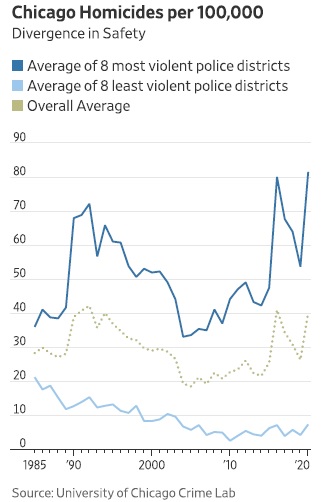
Murders Are Rising the Most in a Few Isolated Precincts of Major Cities

Jon Hilsenrath and Joe Barrett have this article in WSJ, with the subhead “A handful of neighborhoods with histories of violence are the primary source of a recent surge in killings in Chicago, New York and elsewhere.”

As always with crime, there are multiple factors, but what factors are specific to the neighborhoods with the extreme murder rates?

“Researchers have shown the economic and social fabric of neighborhoods is central to crime.” Crime creates a vicious cycle on both the economic and social fronts. When crime is high, businesses leave, taking jobs with them. Law-abiding people who can afford to do so also leave, weakening the social checks against criminality and lesser forms of misbehavior. Continue reading . . .

Austin Voters Reinstate Street Camping Ban

Austin has for some time been regarded as a liberal island in a conservative state, a bit of Berkeley in the heart of Texas. Consistently with that reputation, the city council in 2019 repealed the ban on camping in the streets. Inconsistently with that reputation, the people reinstated the ban last Saturday.

The vote was 57-43, according to this report for KVUE. That is a reasonably healthy majority.
Continue reading . . .