Justice Sandra Day O’Connor

Viet Dinh has this op-ed in the WSJ on Justice Sandra Day O’Connor, who died Friday at the age of 93. Also in WSJ is this editorial, remembering her as a champion of federalism. And indeed she was. Her opinion for the court in Coleman v. Thompson begins, “This is a case about federalism.” As one of the few state court judges elevated to the high court, she had a major role in reining in the excesses of lower federal courts. Those courts often effectively negated the considered decisions of the highest state courts merely because they disagreed with them on debatable points, even though Congress has never given any federal court but the Supreme Court appellate jurisdiction over state courts. When the Supreme Court did get around to resolving the disagreement, it was not unusual for it to decide the state courts had been right and the lower federal courts wrong, especially in the Ninth Circuit.

When Congress went a big step further in that direction than the Supreme Court had done, and farther than Justice O’Connor thought was within the judicial power, she wrote the critical part of the opinion of the court in Williams v. Taylor, enforcing the most important reform as it was written and intended and upholding it as constitutional. Continue reading . . .

Shoplifting Stats

The Council on Criminal Justice has this report on shoplifting statistics. As we have noted on this blog many times and the report acknowledges, these stats have to be taken with caution because they only measure crimes reported to the police. When no-consequences policies lead people to believe (often correctly) that the police will not do anything anyway, reporting likely drops, thereby concealing an increase that may result from the same policies. Further, the report notes, we do not have the backup of the National Crime Victimization Survey that we have for crimes against individuals. The NCVS does not survey businesses.

With that big caveat, the report does have some interesting data. Among the “key takeaways”:

• Shoplifting incidents reported to police have rebounded since falling dramatically in 24 large American cities during 2020. But whether the overall tally is up or down compared with pre-pandemic levels depends on the inclusion of New York City. With New York’s numbers included, reported incidents were 16% higher (8,453 more incidents) in the study cities during the first half of 2023 compared to the first half of 2019; without New York, the number was 7% lower (-2,552 incidents).

The big drop during the pandemic was, obviously, because of the big drop in people going to stores and stores being open. What about the 2023 v. 2019 numbers? I’m skeptical that even without New York overall shoplifting is actually down. A drop is reporting is almost certainly a big factor there. Continue reading . . .

With Crime Surging in DC, Mayor Repaints BLM Mural on Street

In 2020, as rioters were setting fire to parts of Washington, DC, Mayor Muriel Bowser celebrated the group that organized the riots by painting a two block section of 16th Street NW, right outside the White House, with 50 foot tall bright yellow words “BLACK LIVES MATTER.”  Joe Schoffstall of Fox News reports that this month, the Mayor spent over $270,000 to repaint the mural while maintaining cuts to the police budget as crime is increasing dramatically.  According to the DC Metropolitan Police Department, as of November 29,  homicides in the district have increased 32% compared to 2022.  Robberies are up a whopping 69%, with overall violent crime up by 40%.  Motor vehicle theft has almost doubled (93%) compared to last year and other thefts are up 23%.

Continue reading . . .

Gallup: Majority See Crime Increasing

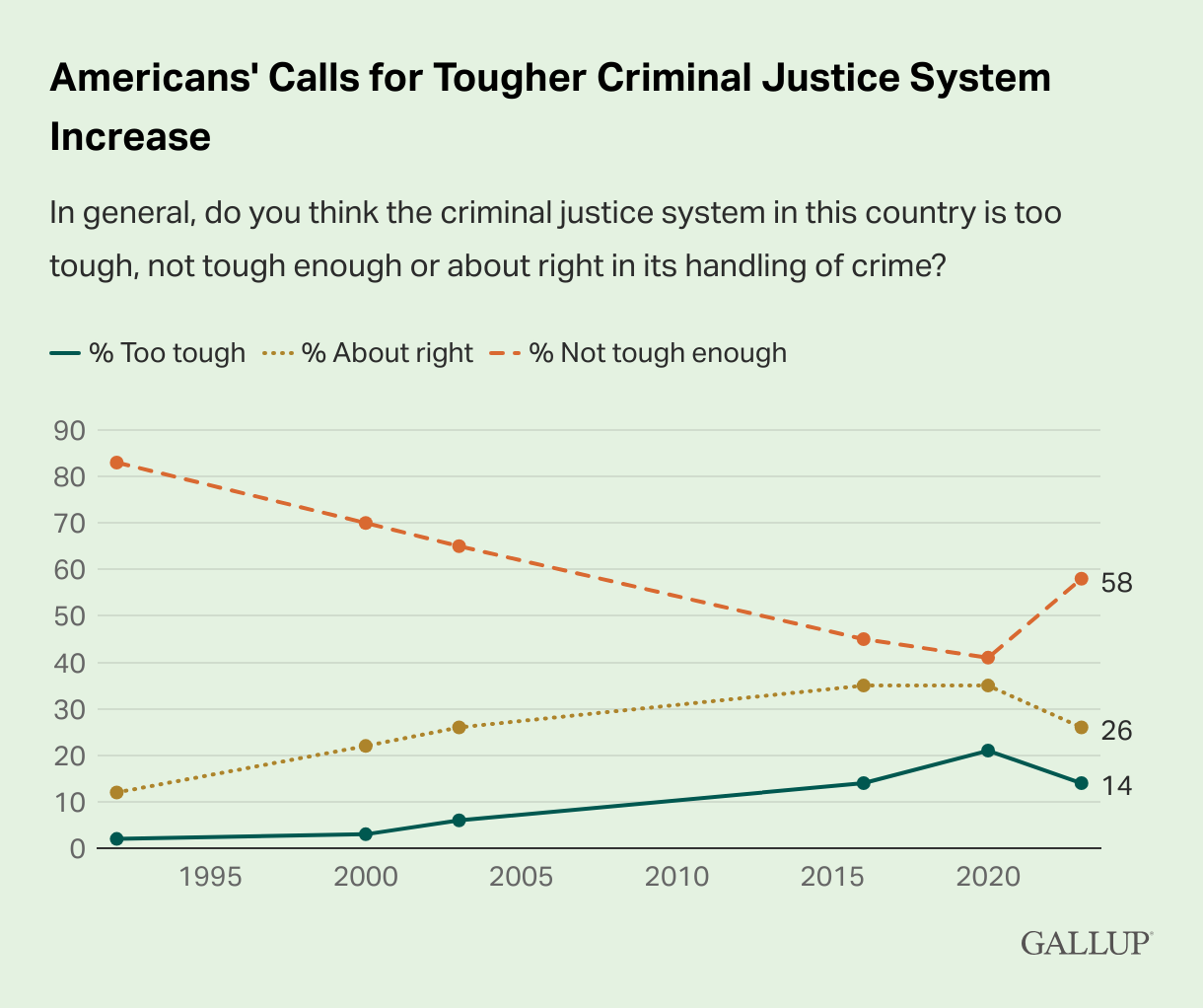
Two recently released Gallup polls here and here found that 63% of Americans consider crime to be extremely or very serious.   77% of respondents believe that crime has increased in the U.S. while 55% see an increase in their own community.  The poll found that 28% reported someone in their household had been a victim of crime over the past 12 months.  Regionally more respondents in the West (64%) felt that crime was higher in their community.  Politically, 92% of Republicans, 78% of Independents and 58% of Democrats believe that crime has increased nationally.  58% reported that the criminal justice system was not tough enough on criminals, while 26% said it was tough enough and 14% said the system was too tough.  According to the survey, about one in three (36%) of crimes go unreported.  I will go out on a limb here and suggest that most of these unreported crimes are property crimes in California, Oregon, Washington State, Illinois, DC, Minnesota, New York and New Jersey where the penalties for property crimes are either so low or nonexistent that no thief fears the law.  55% of respondents believe that strengthening law enforcement is more important than reducing racial bias.  A significant increase from seven years ago. This data suggests that pro-law enforcement candidates running for office next year, are going to have an edge against progressive opponents and incumbents who are committed to defunding the police and ignoring the level of crime committed by different races.

The False Racial Justice Narrative

The socialist/progressive narrative that America’s criminal justice system is systemically racist is endlessly parroted in the mainstream media, although it has been repeatedly proven false.  To address this, some race-baiting pundits expand the narrative to explain that more blacks commit crimes than other races because more blacks are poor, resurrecting the old fiction that poverty is a “root cause of crime.”   Hans Bader discusses this in a Thanksgiving piece in Liberty Unyielding.

Progressives commonly claim the black crime rate is not really higher than the white crime rate, they are merely overpoliced, resulting in blacks being incarcerated more than whites for committing the very same crime. Or that even if the black crime rate is higher, society is really to blame, by driving blacks to crime through economic deprivation and discrimination. Progressives sometimes make both arguments in alternative, as the progressive Washington Post columnist Ruth Marcus once did — she argued that if the black crime rate really is higher than the white crime rate, that reflects even worse on society than if the black crime rate isn’t.

Continue reading . . .

Study Finds No Effect of Gun Buybacks

The Philadelphia Inquirer has this op-ed by Temple University Professor Jerry Ratcliffe and grad student Marc Huffer. Their recently published study adds to the evidence that gun buyback programs are just for show and have no measurable effect on gun crimes. What’s the problem? The programs buy back the wrong guns. The guns the programs buy are brought in by law-abiding folks, while the criminals keep theirs. “Tellingly, Philadelphia’s Office of Forensic Science has never found a National Integrated Ballistic Information Network link to a crime with any gun surrendered in the city’s gun buyback program. Clearly, buyback firearms are not the ones causing such misery in the city.”

That’s consistent with what common sense told us all along, but “never” is a stronger result than I expected. Continue reading . . .

LA District Attorney’s Revolving Door for Criminals

Over the past 18 months Los Angeles police have arrested Dashwan Dow five times for robbery.  On each occasion progressive LA District Attorney George Gascon has refused to hold him, leaving Dow free to find new victims.  Michael Ruiz of Fox News reports that Dow is currently on the loose and considered armed and dangerous.  An October surveillance video shows Dow and an accomplice engage in the follow-home style robbery of a man and a woman in a North Hollywood parking garage.  The video shows Dow sticking a gun in the man’s stomach while stealing his belongings.  Police believe Dow was also involved another follow-home robbery days earlier where he took money and jewelry from another North Hollywood couple.

Continue reading . . .

Soft-on-Crime DA Ousted in DC Exurb

The WSJ has this editorial on the DA’s race is Loudoun County, Virginia. Loudoun is an “exurb” county, one county removed from the collar of Virginia and Maryland counties that border the District of Columbia. The DC suburbs and exurbs have moved steadily left over the years, changing the formerly conservative Virginia into a “swing state.” The WSJ opines, “Voters don’t want politicized prosecutions, and the Virginia vote shows that progressive prosecutors can be defeated even in Democratic-leaning areas no matter how much Soros cash they may have.” Continue reading . . .

Public Support for Tougher Criminal Justice Rebounds

“In general, do you think the criminal justice system in this country is too tough, not tough enough or about right in its handling of crime?” Gallup has asked this question six times since 1992. Initially, 80% of respondents said not tough enough. By 2020, only 41% thought so, though that was still twice many as thought it was too tough. In the latest survey, though, a solid majority of 58% think the system is not tough enough, more than quadruple the number who think it is too tough. Click on the thumbnail for the full-size graph. Megan Brennan has this report for Gallup.

Continue reading . . .

Facing The Truth

The common denominator among city, state and federal governments controlled by democrats is the belief that the criminal justice system is systemically racist.  To prove this, politicians and activists cite government data on traffic stops, arrests, prosecutions and sentences which uniformly show that blacks, which make up 13% of the U.S. population, are many times more likely to interact with law enforcement than other races.  To them, all races commit crimes proportional to their share of the population.  To honor this narrative politicians and democrat voters have enacted and enforced policies to eliminate traffic stops, reduce arrests and prosecutions and reduce or eliminate sentences for all but the most violent crimes.  Manhattan Institute scholar Heather MacDonald wrote about this recently in City Journal, noting how these policies and this narrative came to a head in the summer of 2020 with the George Floyd riots.  Crime has increased dramatically since then and the vastly disproportionate number of victims and the criminals that victimized them were black.  The country’s leaders need to publicly admit this.

Continue reading . . .