Author: Kent Scheidegger

Supreme Court Conference

The U.S. Supreme Court held its first conference of 2024 today. The Court issued three orders after the conference, two of which took up new cases for briefing and argument. One order granted a stay in an abortion case from Idaho and took the case up. Another order took up and fast-tracked the Trump disqualification controversy.

Sometimes the Court issues a short order list of cases granted on the day of the conference and a long list of cases denied on the following Monday. Other times it issues a single list with both on Monday.

Given the unusual nature of both cases taken up today and the need for rapid action, this does not look like the typical short Friday order list situation. I expect that Monday’s list with have both grants and denials.

There were two cases scheduled for today’s conference where CJLF wrote or assisted with a brief: Grants Pass v. Johnson, involving the Ninth Circuit’s theory that the Eighth Amendment severely limits cities’ ability to ban camping on public property, and Glossip v. Oklahoma, involving repeated attacks on a murder conviction. Continue reading . . .

The Indirect Consequences of Crime

Efforts to measure the costs of crime generally focus on direct effects. They try to place a monetary value on the loss to victims and tally the cost to governments of dealing with crime. Yet looking only to direct effects and ignoring indirect effects is a major source of error in public policy. The indirect effects of crime are large and important. Brian Patrick Eha has a two-part essay in the City Journal titled The Element of Crime, exploring these issues. Part one is here. His focus is on New York, the place he knows best, but the theme is universal.

To live in New York today is to experience, on a regular basis, visibly and abrasively, the element of crime. By this, I mean more than run-ins with the “criminal element,” that is, serious offenders, though such encounters are more frequent. I mean not only, for instance, the 25 times that someone was pushed onto subway tracks in 2022—four more times than in 2021—but also the countless small infractions, spit in the eye of the body politic, the casual disrespect for law and common decency: the picnic table covered in food waste and Kool-Aid pouches when a trash can is two feet away; the pharmacy with locked cabinets for such valuables as fruit juice and deodorant; the requirement, at the Metropolitan Museum of Art’s recent Van Gogh exhibit, to empty your water bottle before entering the gallery, for fear that some vandal might smuggle in a substance with which to desecrate the art, as has happened at more than a dozen museums over the past year.  I mean, in short, all the demoralizing effects of which pervasive crime is the cause, the impact that lawlessness and an inescapable awareness of it—to say nothing of official resignation or indifference—has on society and the psyche. Continue reading . . .

New SCOTUS Criminal Cases

The U.S. Supreme Court accepted seven cases for full briefing and argument last Wednesday. Four of them are criminal, habeas corpus, or law-enforcement-related civil cases.

Thornell v. Jones, No. 22-982, is a capital habeas case in which the murderer’s claims of ineffective assistance were rejected by the state trial court, the state supreme court, and the federal district court, but a three-judge panel of the Ninth Circuit decided that all the prior courts were wrong, despite the deference due to state courts’ resolution of claims on the merits and trial courts’ decisions on question of fact. Continue reading . . .

More on Shoplifting Stats

A couple of updates on prior reports of shoplifting statistics:

The National Retail Federation has revised its earlier report on retail losses due to crime, which we reported here. The statistic of $95 billion, noted in our post, stands. However, the NRF withdrew its claim that half of that total was from organized retail crime. The fraction from organized, rather than individual, theft is unknown at present. See this article by Anne D’Innocenzio for AP, in the WaPo. From the article: Continue reading . . .

Justice Sandra Day O’Connor

Viet Dinh has this op-ed in the WSJ on Justice Sandra Day O’Connor, who died Friday at the age of 93. Also in WSJ is this editorial, remembering her as a champion of federalism. And indeed she was. Her opinion for the court in Coleman v. Thompson begins, “This is a case about federalism.” As one of the few state court judges elevated to the high court, she had a major role in reining in the excesses of lower federal courts. Those courts often effectively negated the considered decisions of the highest state courts merely because they disagreed with them on debatable points, even though Congress has never given any federal court but the Supreme Court appellate jurisdiction over state courts. When the Supreme Court did get around to resolving the disagreement, it was not unusual for it to decide the state courts had been right and the lower federal courts wrong, especially in the Ninth Circuit.

When Congress went a big step further in that direction than the Supreme Court had done, and farther than Justice O’Connor thought was within the judicial power, she wrote the critical part of the opinion of the court in Williams v. Taylor, enforcing the most important reform as it was written and intended and upholding it as constitutional. Continue reading . . .

Shoplifting Stats

The Council on Criminal Justice has this report on shoplifting statistics. As we have noted on this blog many times and the report acknowledges, these stats have to be taken with caution because they only measure crimes reported to the police. When no-consequences policies lead people to believe (often correctly) that the police will not do anything anyway, reporting likely drops, thereby concealing an increase that may result from the same policies. Further, the report notes, we do not have the backup of the National Crime Victimization Survey that we have for crimes against individuals. The NCVS does not survey businesses.

With that big caveat, the report does have some interesting data. Among the “key takeaways”:

• Shoplifting incidents reported to police have rebounded since falling dramatically in 24 large American cities during 2020. But whether the overall tally is up or down compared with pre-pandemic levels depends on the inclusion of New York City. With New York’s numbers included, reported incidents were 16% higher (8,453 more incidents) in the study cities during the first half of 2023 compared to the first half of 2019; without New York, the number was 7% lower (-2,552 incidents).

The big drop during the pandemic was, obviously, because of the big drop in people going to stores and stores being open. What about the 2023 v. 2019 numbers? I’m skeptical that even without New York overall shoplifting is actually down. A drop is reporting is almost certainly a big factor there. Continue reading . . .

Study Finds No Effect of Gun Buybacks

The Philadelphia Inquirer has this op-ed by Temple University Professor Jerry Ratcliffe and grad student Marc Huffer. Their recently published study adds to the evidence that gun buyback programs are just for show and have no measurable effect on gun crimes. What’s the problem? The programs buy back the wrong guns. The guns the programs buy are brought in by law-abiding folks, while the criminals keep theirs. “Tellingly, Philadelphia’s Office of Forensic Science has never found a National Integrated Ballistic Information Network link to a crime with any gun surrendered in the city’s gun buyback program. Clearly, buyback firearms are not the ones causing such misery in the city.”

That’s consistent with what common sense told us all along, but “never” is a stronger result than I expected. Continue reading . . .

Soft-on-Crime DA Ousted in DC Exurb

The WSJ has this editorial on the DA’s race is Loudoun County, Virginia. Loudoun is an “exurb” county, one county removed from the collar of Virginia and Maryland counties that border the District of Columbia. The DC suburbs and exurbs have moved steadily left over the years, changing the formerly conservative Virginia into a “swing state.” The WSJ opines, “Voters don’t want politicized prosecutions, and the Virginia vote shows that progressive prosecutors can be defeated even in Democratic-leaning areas no matter how much Soros cash they may have.” Continue reading . . .

Public Support for Tougher Criminal Justice Rebounds

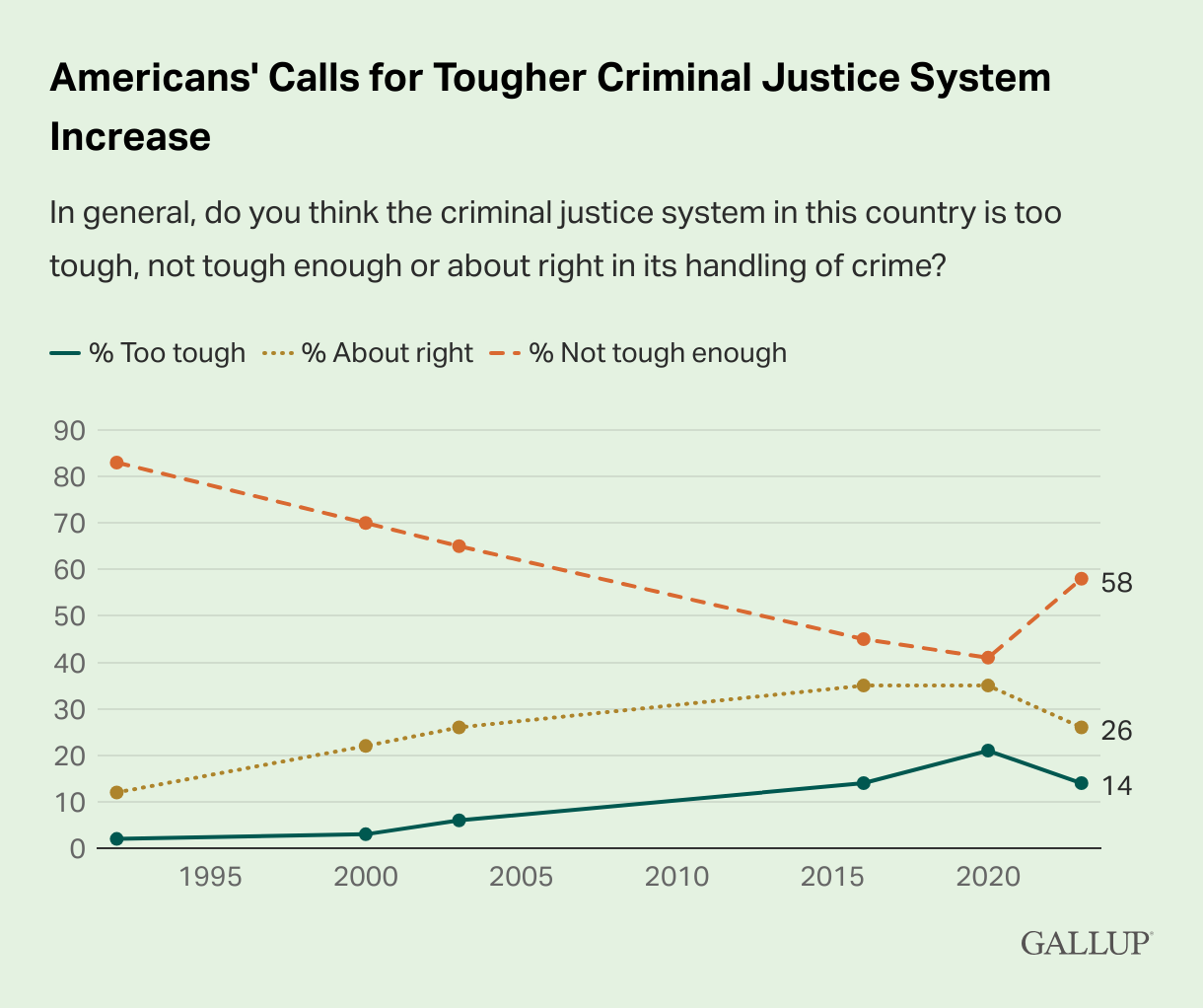
“In general, do you think the criminal justice system in this country is too tough, not tough enough or about right in its handling of crime?” Gallup has asked this question six times since 1992. Initially, 80% of respondents said not tough enough. By 2020, only 41% thought so, though that was still twice many as thought it was too tough. In the latest survey, though, a solid majority of 58% think the system is not tough enough, more than quadruple the number who think it is too tough. Click on the thumbnail for the full-size graph. Megan Brennan has this report for Gallup.

Continue reading . . .

Alarming Rise in Carjacking by Juveniles in DC

Liam Bissainthe has this post at Liberty Unyielding, reporting that carjacking in DC is up 600% over 2019. The post cites this report from WTOP on October 3, reporting that as of that date there had been 750 carjackings in 2023, 75% of them involving guns. Nearly two-thirds of the persons arrested for carjacking to that date were juveniles.

Why do so many DC juveniles commit this violent crime?

Continue reading . . .