Author: Kent Scheidegger

FedSoc Executive Branch Review

The Federalist Society’s Annual Executive Branch Review is next week, Monday through Thursday, online. It’s free unless you need continuing education credits for the Wednesday session. There is a fee for the required CE materials.

There is no panel specifically on criminal law. We decided to separate the forthcoming “progressive prosecutor” panel to a stand-alone event. Stay tuned for details on that. However, there are a number of good programs on other topics of federalism and separation of powers on tap.

Thursday afternoon, there is is a panel on judicial nominations and confirmations, a matter of great interest to those who practice criminal law. The panel description follows the break: Continue reading . . .

How the District Attorney Playbook Has Changed

Michael Smerconish has this video report on CNN. With a focus on Philadelphia, he begins by noting the change from prosecutors who ran for office by touting how tough they were to the more recent “progressive prosecutor” model, heavily reliant on large sums of campaign cash from George Soros.

However, Mr. Smerconish notes, there are signs of a trend in the other direction, with a strong challenger to Philly DA Krasner and recall efforts against SF DA Boudin and LA DA Gascón. Continue reading . . .

The High Cost of Hyperbole About Police Killings of Kids

The Atlantic has an article with the above caption as the HTML web page title. The article headline and subhead are “The Numbers Tell a Different Story About Police Killings of Minors: Exaggerated narratives could yield misguided policy responses—which would endanger many more kids.”

Sensational but rare events have always assumed outsize proportion in popular reaction. That reaction can often lead to wrong policy choices and sometimes disastrous ones. Author Conor Friedersdorf compares the perception to the reality and notes,

false or hyperbolic characterizations of police killings of minors carry a cost: They traumatize members of the public more than the facts justify, unfairly vilify cops, and mislead people about the best way forward.

Continue reading . . .

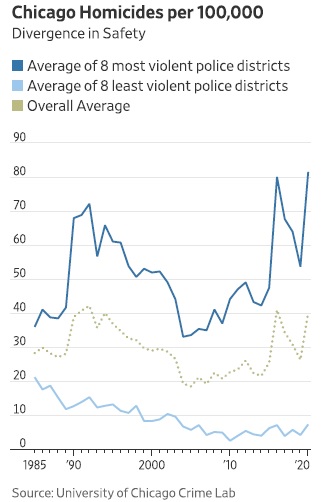
Murders Are Rising the Most in a Few Isolated Precincts of Major Cities

Jon Hilsenrath and Joe Barrett have this article in WSJ, with the subhead “A handful of neighborhoods with histories of violence are the primary source of a recent surge in killings in Chicago, New York and elsewhere.”

As always with crime, there are multiple factors, but what factors are specific to the neighborhoods with the extreme murder rates?

“Researchers have shown the economic and social fabric of neighborhoods is central to crime.” Crime creates a vicious cycle on both the economic and social fronts. When crime is high, businesses leave, taking jobs with them. Law-abiding people who can afford to do so also leave, weakening the social checks against criminality and lesser forms of misbehavior. Continue reading . . .

Austin Voters Reinstate Street Camping Ban

Austin has for some time been regarded as a liberal island in a conservative state, a bit of Berkeley in the heart of Texas. Consistently with that reputation, the city council in 2019 repealed the ban on camping in the streets. Inconsistently with that reputation, the people reinstated the ban last Saturday.

The vote was 57-43, according to this report for KVUE. That is a reasonably healthy majority.
Continue reading . . .

Baltimore’s Disastrous Experiment with De-Policing

Stephen J.K. Walters writes in the City Journal:

A decade ago, Baltimoreans became lab rats in a fateful experiment: their elected officials decided to treat the city’s long-running crime problem with many fewer cops. In effect, Baltimore began to defund its police and engage in de-policing long before those terms gained popular currency.

This experiment has been an abject failure. Since 2011, nearly 3,000 Baltimoreans have been murdered—one of every 200 city residents over that period. The annual homicide rate has climbed from 31 per 100,000 residents to 56—ten times the national rate. And 93 percent of the homicide victims of known race over this period were black.

Walters traces the history, which ironically includes an attempt to emulate the “Broken Windows” approach to policing that James Q. Wilson and George Kelling proposed in their famous 1982 Atlantic article. The approach had worked very well in New York, back when New Yorkers knew how to elect good mayors.

The problem, Walters says, is that Baltimore’s attempt was pathetically bad. Continue reading . . .

Dumping a Dishonest Precedent Less Than Honestly — Part II

In Jones v. Mississippi, decided April 22, the U.S. Supreme Court held that in cases where a juvenile is facing life without parole (LWOP) for murder, all that is needed to comply with its 2012 precedent in Miller v. Alabama is for the sentencing court to have discretion to choose a lower sentence and consider the defendant’s youth in making the choice.

That would have been fairly straightforward based on Miller itself. The complications arose from the 2016 decision in Montgomery v. Louisiana, making Miller retroactive so as to require resentencing for a 1963 murder. The problem, as explained at length in the previous post, is that Montgomery contradicted Miller in order to achieve that result, and Montgomery even contradicted itself, making statements that cannot be reconciled.

In Jones, the majority opinion joined by five Justices and the dissent joined by three have many sharp points of disagreement, but they agree on one thing. Both maintain the fiction that Montgomery is consistent with Miller. As a result, neither opinion’s analysis can possibly be completely correct, and neither is. Continue reading . . .

Older Women Stabbed at SF Bus Stop in Broad Daylight

A man attacked two older women waiting for a bus on Market Street in the heart of San Francisco in broad daylight and then casually walked away. One was in her 60s and one was in her 80s. Both are out of surgery and in the ICU as of this writing. A suspect has been arrested, described only as a San Francisco man in his 50s.

Kate Larson has this report for KGO. A witness who works at a nearby flower stand said, “I feel like we do need more officers patrolling.” The member of the Board of Supervisors who represents the district said, “We have to hold people accountable who are committing crimes like this, we have to have police in areas where people need to be safe and have them more visible.”

In other words, everything the “woke” crowd is saying is wrong, and we need an about-face in criminal justice policy. We need it right now. Continue reading . . .