Category: Sentencing

Deja Vu All Over Again

A March 4 article by By Paul Demko, Jeremy White and Jason Befferman published in POLITICO reports that liberal Democrat politicians in some of the nation’s most progressive cities are abandoning the soft-on-crime policies that they vigorously supported a few years ago. Back in 2020, as the George Floyd riots were tearing up these same cities, politicians running New York, Washington DC, Chicago, Baltimore, Seattle, Portland, Los Angeles and San Francisco were insisting that sentences for so-called “low level” drug and theft related crimes be reduced, that cash bail be eliminated and that criminals, including violent gang members, be released early to rehabilitation programs. The motivator for these policies was the systemic racism narrative promoted by progressive academics, non-profits like Black Lives Matter, race-baiting politicians and the national media. While this narrative had been pushed since the 1990s, it got major traction after Floyd’s death as deep blue cities reflexively cut police budgets, elected pro-defendant prosecutors and swept away consequences for crime. Then something happened.
Continue reading . . .

Cal. Supreme Ct. Upholds Life-Without-Parole for Young Adult Murderers

A California law, enacted directly by the people, provides that the crime of first-degree murder with special circumstanhe ces committed by an adult is punishable by death or life in prison with no possibility of parole. Yet Tony Hardin, who committed a vicious murder at age 25, claimed that the Equal Protection Clause of the Fourteenth Amendment requires that he be considered for parole anyway because others who committed lesser degrees of murder at the same age are eligible for “youth offender parole” under California law. A California Court of Appeal panel actually bought that. The California Supreme Court rejected this claim in a 5-2 decision yesterday, reversing the Court of Appeal. Continue reading . . .

Coalition Grows to Overhaul California’s Thief-Friendly Law

The San Francisco Chronicle has this article on Mayor London Breed joining the coalition to overhaul California’s disastrous Proposition 47. And of course, being the Chronicle, the main thing they emphasize about the initiative is that it is “GOP-led,” generally regarded as a kiss of death in The City.

But Mayor Breed is not the only Democrat to climb on the fix-47 bandwagon. Continue reading . . .

The Persistent Myths of Mass Incarceration

Professor Paul Robinson and a fellow colleague from Penn have posted an in-depth article that is worth a read.  The abstract, sans the roadmap:

Few claims have won such widespread acceptance in legal academia as the “mass incarceration” narrative: the idea that the rise in America’s prison population over the last half century was fueled largely by the needless and unjust imprisonment of millions of criminal offenders due to punitive changes in sentencing. To many academics and activists, the question is not how accurate the mass incarceration narrative is, but how mass incarceration can be ended. This Article argues the “mass incarceration” narrative is based on a series of myths and, as a result, many proposed reforms are based on a misunderstanding of America’s past and present carceral practices. A more accurate understanding is needed to produce effective reform.

The central myth of the mass incarceration narrative is that exceptional and unjustified punitiveness largely explains America’s significant increase in prison population since the 1960s. This explanation overlooks the numerous non-sentencing factors that increased incarceration: a near doubling in U.S. population, higher crime rates, increased justice system effectiveness, deinstitutionalization of the mentally ill, new and tightened criminalizations, worsening criminal offender histories, and more. While this Article makes no attempt at statistical precision, these non-sentencing factors can easily explain most of America’s elevated incarceration compared to the 1960s—a fact in direct conflict with the mass incarceration narrative. Additionally, while some punishments have increased in severity since the 1960s, most of these increases are likely to be seen as moving sentences closer to what the community – and many incarceration reformers – would believe is appropriate and just, as in cases of sexual assault, domestic violence, stalking, human trafficking, firearm offenses, and child pornography, among others. Continue reading . . .

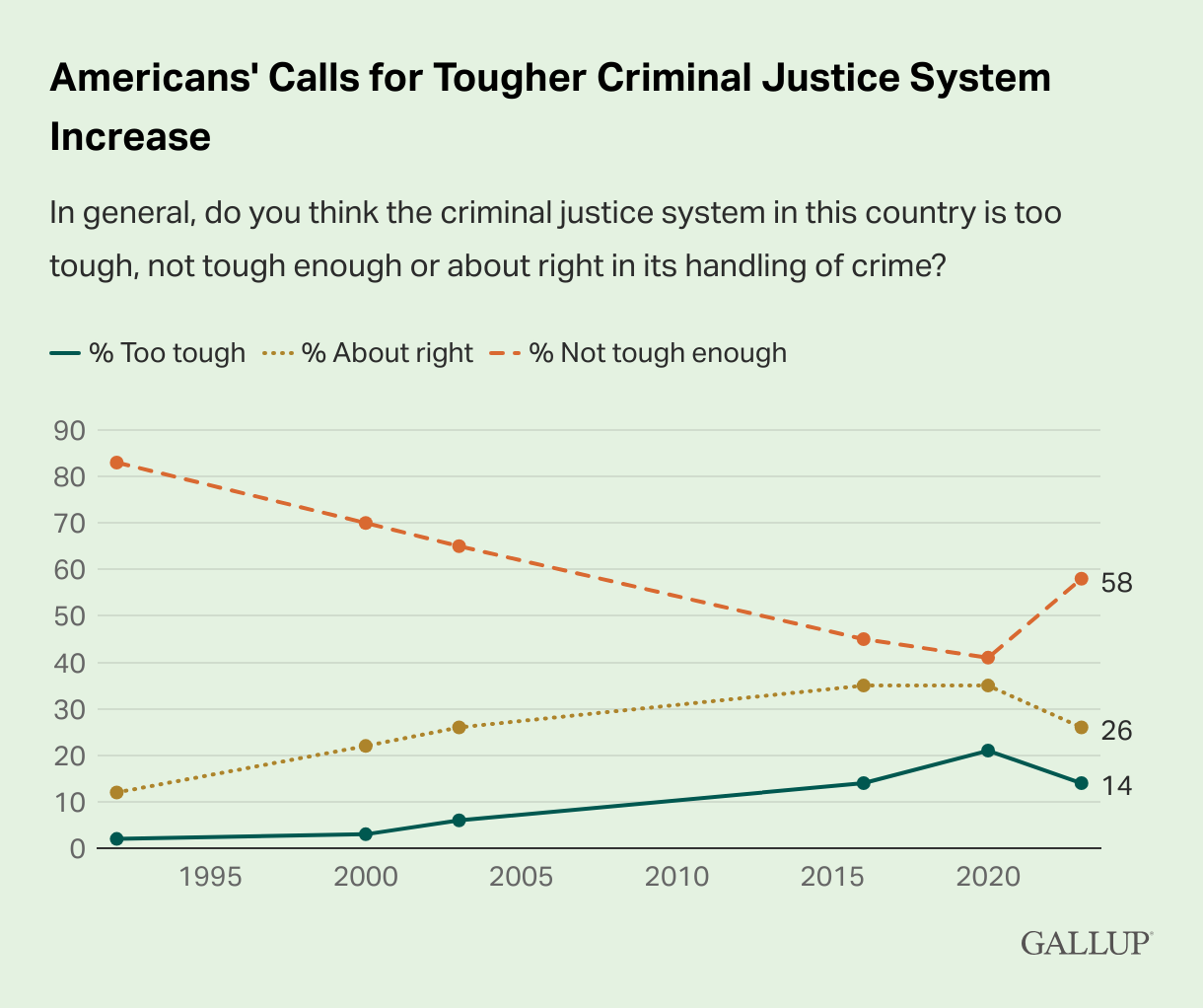
Public Support for Tougher Criminal Justice Rebounds

“In general, do you think the criminal justice system in this country is too tough, not tough enough or about right in its handling of crime?” Gallup has asked this question six times since 1992. Initially, 80% of respondents said not tough enough. By 2020, only 41% thought so, though that was still twice many as thought it was too tough. In the latest survey, though, a solid majority of 58% think the system is not tough enough, more than quadruple the number who think it is too tough. Click on the thumbnail for the full-size graph. Megan Brennan has this report for Gallup.

Continue reading . . .

Defining “Violent”

One would not think that defining “violent crime” is all that difficult. Yet in both federal law and California law, there are definitions of “violent” that are excessively narrow, excluding crimes that everyone with sense would consider violent. Dan Walters has this column at CalMatters, titled “California law treats some violent crimes as nonviolent, letting offenders off the hook.” He has an extended quote from this column by Emily Hoeven at the SF Chronicle (behind a paywall).

From Walters’ column:

Hoeven noted that earlier this year, the Assembly’s (perhaps misnamed) Public Safety Committee rejected a Republican bill to classify domestic violence as a violent crime, thereby making it easier to keep offenders behind bars.

This outrageous situation results from a 2016 ballot measure, sponsored principally by then-Gov. Jerry Brown and passed by voters, that purported to give those who commit nonviolent crimes chances to earn their way out of prison.

However, it was deceptive. Proposition 57’s indirect definition of a nonviolent crime was that it did not appear on a specific Penal Code list of 23 violent crimes.

That list only referred to particularly heinous crimes and omitted many offenses that ordinary folks would consider violent, including some forms of rape and domestic violence. The result is that those who commit some unspeakable crimes, including battering one’s spouse, are given kid gloves treatment in the penal system.

How did the definition get so screwed up? The problem in California is, in substantial part, the result of lazy drafting. (The federal problem is a topic for another post.) Continue reading . . .

SB 94 – Lies, Damn Lies, and Statistics – Murderers do not “Age Out”

Steve Smith of Pacific Research Institute has this post on a bill that is exceptionally bad even by the California Legislature’s low standards. The bill  would make a large number of murderers sentenced to life without possibility for parole eligible for parole.  Smith notes:

SB 94 is based on the simplistic and poorly researched premise that, based on arrest statistics alone, criminals age out of crime. The bill’s author, Senator Dave Cortese, argues that “research overwhelmingly shows that people age out of violent crime….”

Both [Sen. Cortese’s] press release and the study [it cites] suffer from a glaring omission. Neither make the connection between age and the crimes for which the offender was sentenced. Continue reading . . .

Inadequate analysis yields unintended consequences

Syndicated columnist Thomas Elias has this column with the above title on the consequences of California’s sentence-reducing ballot propositions of the previous decade, Proposition 47 of 2014 and Proposition 57 of 2016.

Here’s a reality that needs to soak into the consciousness of California lawmakers, the governor and voters who put them in office: This state needs far better analysis and vetting of new laws if it’s to avoid negative unintended consequences.

And when we get solid analysis and reliable predictions of some consequences, we need to pay heed, not ignore reality.

These facts of life are perhaps best illustrated by the 2014 Proposition 47, which ended felony status for thefts and burglaries involving less than $950 worth of goods and reduced some other felonies, like stealing a gun, to misdemeanors.

One unintended consequence has been closure of some stores, notably Walgreen’s and Whole Foods outlets that suffered constant shoplifting and no penalties for thieves caught red-handed. That’s an inconvenience making life more complex from San Francisco to San Diego.

Continue reading . . .

Human trafficking is still not “serious” in California

(7/14 — see update at end of post)

Two months ago, I reported that a bill to make human trafficking a “serious felony” in California, and thus apply the state’s recidivism laws to people who commit it, was watered down in the Senate Public Safety Committee to apply only to trafficking of minors. A majority of that committee apparently believes that actual slavery of adults in the 21st century is not serious enough to apply the same laws that apply to robbery and home burglary.

Well, that wasn’t watered down enough for the Democrats on the Assembly Public Safety Committee, Katy Grimes reports in the California Globe. Continue reading . . .

Accountability for Crime in California?

The Right Message, Wrong Messenger Award for today goes to the owner of several San Francisco retail businesses, who said this:

My biggest gripe right now in San Francisco has been, frankly, we’re not enforcing existing laws … we’re not prosecuting the law breakers. Judges, DAs, the whole panoply — I want to see people held accountable for breaking the law.

Notice that the California Governor is missing from the list. So why is this person the wrong messenger? Continue reading . . .