Category: Studies and Statistics

More Cops, Less Crime, Big Data

Common sense tells us that more cops on the beat should reduce crime. That was why, at the peak of America’s crime rates, Bill Clinton’s promise to put 100,000 cops on the beat struck a resonant chord with a great many Americans. But while common sense is usually right it is not always, so empirical research is needed.

Charles Lehman reports in the City Journal on research by Sarit Weisburd of Tel Aviv University using GPS data from Dallas police cars. “Weisburd demonstrates that cutting police presence leads to a dramatic increase in crime and offers compelling evidence that this effect is driven by a drop in routine patrols. Cops on the beat drive down crime.” Continue reading . . .

Is the United States “Incarceration Nation”?

Kent discussed here the recently released BJS Report showing that the prison population in America declined again last year.  “Reform” advocates are likely to use the report as evidence that declining incarceration does not result in more crime.  As Kent explains, this is so much sleight of hand.  Part of the overall decrease in crime rates over the last decade stems from the trend in some large states to simply refuse to label more and more anti-social behavior (e.g., retail theft, small-time drug use) as crime, and part results from systemic delay, to wit (1) the delay between cause and effect, and (2) the delay between the commission of crime, its adjudication, its collection in crime statistics, and the statistics’ publication.

Still, it’s worthwhile looking at the BJS statistics themselves.  Even with their shortcomings, they tell a very different story from the one you’re going to hear from “reform” advocates. Continue reading . . .

Imprisonment Rate Down, But Why?

The U.S. Bureau of Justice Statistics has released its annual report on prisoners for 2019. The “imprisonment rate,” defined as number of sentenced prisoners per 100,000 population, continued to decline, as it has since peaking in 2007.

While many people obsess about the imprisonment rate, I consider it to be a statistic of little value, at least by itself. Why is it down? Is it down because crime is down? Because legislatures lowered statutory penalties? Because prosecutors use their discretion not to charge every crime a defendant has committed more often? Because judges use their discretion in sentencing more leniently? Continue reading . . .

California v. National Crime Trends

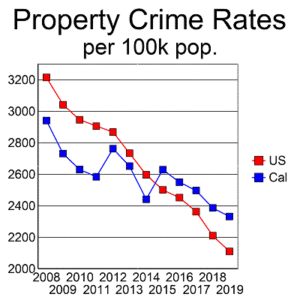
Here is an update of the post two years ago comparing California’s crime rates with those of the country as a whole.

The trend remains as I noted it then. Since California began its reckless drive to reduce prison populations regardless of the consequences, it has not shared in the property crime drop to the same extent as the rest of the country. For violent crime, the 2015-2016 increase was much larger, and it has not receded to the same degree as the rest of the country. Continue reading . . .

Crimes Known to Police Continued Decline in 2019

The FBI has released its annual final report on crime for last year, Crime in the United States, 2019. Nationwide, the rates per 100,000 population decreased 1% for violent crime and 4.5% for property crime. This data set does not include crimes not reported to or otherwise known to the police. As we have discussed on this blog previously, the change of many crimes from felonies to misdemeanors is likely to decrease reporting as the police are less likely to take any worthwhile action.

As noted last year and in multiple previous years, California has not fully shared in the national crime decline in property crime since it started its decarceration project. Continue reading . . .

Crime Rates Up and Down in First Half of 2020

Crime Change Graph The FBI has released its preliminary crime report for the first half of 2020. In this unprecedented year, we see crime rate changes varying widely by crime. Rates for rape, robbery, burglary, and most thefts are down, probably because of more people staying home. Rates for murder and arson are up sharply, and there are substantial increases in aggravated assault and auto theft as well. Continue reading . . .

As the Police Are Scorned and “Progressive” Prosecutors Settle In, Murder Explodes Across America

The New York Times today makes some efforts to explain away the story, but for the most part tells it straight up:  Murder is surging in cities across the country:

Overall crime is down 5.3 percent in 25 large American cities relative to the same period in 2019, with violent crime down 2 percent.

But murder in these 25 cities is up 16.1 percent in relation to last year. It’s not just a handful of cities driving this change, either. Property crime is down in 18 of the 25 sampled cities, and violent crime is down in 11 of them, but murder is up in 20 of the cities.

Continue reading . . .

What the Data Say About Police

Roland Fryer, professor of economics at Harvard, wrote this op-ed for the WSJ, published yesterday.

In 2015, after watching Walter Scott get gunned down, on video, by a North Charleston, S.C., police officer, I set out on a mission to quantify racial differences in police use of force. To my dismay, this work has been widely misrepresented and misused by people on both sides of the ideological aisle.

Continue reading . . .