Category: Social Factors

Will the Violent Crime Surge Spark Electoral Pushback?

Rich Lowry writing in Politico thinks so.  His piece is titled, “Democrats Ignore the Crime Spike at Their Own Peril.”

On the anniversary of the death of George Floyd, dozens of gunshots rang out in the middle of the day at George Floyd Square in Minneapolis, forcing reporters and bystanders to duck and cover.

The symbolism was unmistakable—the yearlong bout of protest and activism after Floyd’s killing has coincided with a surge of urban crime that has made gunplay dismayingly common.

Will the electorate react in next year’s elections?
Continue reading . . .

Effects of ‘Defunding’ Law Enforcement and Reducing Consequences for Crimes

The Wall Street Journal has this article by Jason Riley addressing a few early outcomes we are seeing as a result of lowering prosecution rates and defunding law enforcement in many large cities across the U.S. Riley points out the following:

In New York City, shooting and homicides rose by 97% and 44%, respectively, in 2020, and felony assaults are up by 25% this year. Yet seven of the eight candidates running in the Democratic primary for Manhattan district attorney have pledged to cut the police budget or prosecute fewer suspects—or some combination of the two. Baltimore began defunding law enforcement and turning a blind eye to criminal behavior a decade ago, and since then nearly 3,000 of its residents have been murdered. 


Continue reading . . .

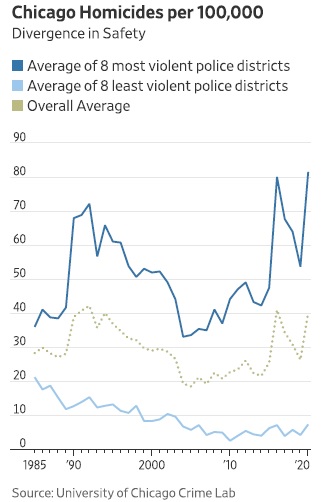
Murders Are Rising the Most in a Few Isolated Precincts of Major Cities

Jon Hilsenrath and Joe Barrett have this article in WSJ, with the subhead “A handful of neighborhoods with histories of violence are the primary source of a recent surge in killings in Chicago, New York and elsewhere.”

As always with crime, there are multiple factors, but what factors are specific to the neighborhoods with the extreme murder rates?

“Researchers have shown the economic and social fabric of neighborhoods is central to crime.” Crime creates a vicious cycle on both the economic and social fronts. When crime is high, businesses leave, taking jobs with them. Law-abiding people who can afford to do so also leave, weakening the social checks against criminality and lesser forms of misbehavior. Continue reading . . .

Is Racism a Driving Force in Fatal Police-Citizen Encounters?

In the aftermath of the police shooting of knife-wielding black teenager Ma’Khia Bryant (in the course of her attack on an unarmed black teenager), and of the Derek Chauvin verdict, President Biden made these racially fraught remarks to Congress tonight:

We have all seen the knee of injustice on the neck of Black America. Now is our opportunity to make real progress. Most men and women in uniform wear their badge and serve their communities honorably. I know them. I know they want to help meet this moment as well.  My fellow Americans, we have to come together. To rebuild trust between law enforcement and the people they serve. To root out systemic racism in our criminal justice system.

So what’s the truth here?  Was “systemic” (or other) racism the cause of the killing of either George Floyd or Ma’Khia Bryant?  And is there a wall of distrust between law enforcement and the people they serve?

Continue reading . . .

Who Killed Adam Toledo?

Rafael Mangual asks and answers the above rhetorical question in this article in City Journal.

Most news coverage and discussion of controversial uses of force by police zoom in on a brief snippet of video, leaving out the context. That is a huge mistake, Mangual argues:

The immediate cause of Toledo’s death was the bullet fired by Officer Stillman. But it’s worth examining how a 13-year-old boy ended up in a full sprint through a dark alley at 2:30 AM with a gun in his hand and a police officer on his tail. Continue reading . . .

Junk Science

There is a lot of junk in psychology today, Jesse Singal tells us in this article in the WSJ. The title in tomorrow’s print edition is “The False Promise of Quick-Fix Psychology Why We Keep Falling For Fad Psychology.”

Some of this junk impacts criminal justice and law enforcement issues. Continue reading . . .

Covid-19 and Economic Hardship are not Responsible for Spike in Murder Rates

A blog post by Hans Bader of Liberty Unyielding presents a comparison between the United States and Latin America in response to the notion that the rise in homicide rates in 2020 is a result of the pandemic and citizens being desperate for means to support themselves. Bader notes, “In reality, murder rates fell in much of the world during the pandemic. People’s situation was far more desperate in Latin America, where the pandemic left many people without adequate food, yet murder did not increase in many Latin American nations.”  While in the United States homicides greatly increased in many major cities.

Continue reading . . .

Misconceptions About Mass Shootings in the U.S.

The manner in which the media reports on mass shootings leads the viewers to believe these rare instances are much more common than they are. Additionally, there is a false narrative floating around that more strict gun control legislation and more rigorous screening processes at gun stores would solve the issue. An article published in The Trace today addresses this misreporting. 

Continue reading . . .

Portland Economy Suffers at the Hands of Violent Protesters

In an article this morning by Ian Lovett of the Wall Street Journal, the months of protests that often led to riots and violence in Downtown Portland are now hindering the recovery of the economy. Lovett points out, “The violence downtown has become a persistent roadblock in Portland’s attempts to reopen and revive its economy as vaccinations spread, Covid-19 cases fall, and business restrictions are loosened.” Many small businesses have been forced to close their doors for months, while others have had to close them permanently due to the riots that began last June. 

Continue reading . . .